Here it is, my 3E to 2E Skunk Works Template.
While there exist several good conversion descriptions for
taking your 2E whatever to 3E, you pretty much have to start from scratch converting a 3E to 2E. I've been winging it on a monster by monster basis, but I'm going to try to codify some of what I've been doing here. Mostly so it is written down someplace to help me remember how I'm doing it.
If anyone has any comments or suggestions (besides,
"Dude, join the party and just learn 3E!") I'd welcome them.
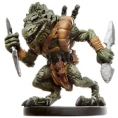
I'll use the one I'm working on this morning, the Greenspawn Sneak from Blood War.
The first thing I do is create a Compendium style sheet for it in Publisher 2000. (No, I don't feel the same way about Publisher 2000 that I do about 2E, and will update when I wouldn't rather spend my extra money on new miniatures.)
Then I take a picture of the mini, which is hard to do now since I had to give the camera I was using for that purpose back to the school I no longer work for...but to be fair it was nice of them to let me keep using it all summer and half a semester after I started teaching at a new university. The whole point of this exercise was to have a compendium that used pics of minis instead of the TSR artwork, so I'll have to find a new camera somewhere. The images on the WOTC website, besides being copyrighted, are way too small to be useful for this project.
Then I have to find out which, if any, of the many shiny and expensive new 3E books the creature is listed in--not always easy--and obtain that book. I try to buy them on eBay.
"Dude, you mean you're buying the 3E books and not using them? That's whack. Dude, grow up and just play 3E, man." Look, I told you. I prefer 2E whether I have the 3E books or not.
"Whatever, dude, but all the time you spend converting, wouldn't you rather spend actually playing something?"No. Now, go write your own blog and get out of my head.
Ahem. As I was saying, if I can't find the creature in one of the books, I'll use the stat card it came with, but this won't give me many of the details since the miniatures game is even less concerned with ecologies, habitats, and other background information than 3E in general.
CLIMATE/TERRAIN: For this, you need to scan the text entries for a section called
Environment. In this case, temerpate forests and marshes.
FREQUENCY: For this, you need to read the entire article to get a sense of how often the creature might be encountered, as there is no direct indication. I run a Forgotten Realms campaign, so the section at the end which discusses ecology specific to that setting usually gives a few clues. Sometimes in the 3E sourcebooks it will list this number under the Organization heading in the stats chart.
ORGANIZATION: You have to check both the
strategies and tactics and the
society section in order to come up with this information, though sometimes you get lucky and they come right out and say it in the
sample encounters. Some 3E sourcebooks have an Organization heading in their stats charts.
ACTIVITY CYCLE: Again, the only thing you can do is read the whole entry and make a guess.
DIET: This information will often be given in the
ecology section of the 3E entry.
INTELLIGENCE: This one is easy, as 3E gives all of the ability scores for monsters. I will admit that this is an improvement on 2E. The one that doesn't seem to translate perfectly is Strength because of the changes to exceptional abilities. Use this chart:
3E Exceptional ST = 2E Equivalent19 = 18/01–18/50
20 = 18/51–18/75
21 = 18/76 –18/90
22 = 18/91–18/99
23 = 18/00
24 = 19–20
25 = 21–22
26 = 22–23
27 = 24–25
TREASURE: It is really diffucult to convert the information in the
typical treasure section to the 2E treasure tables. Nearly impossible, really. I usually try to find a similar creature in the 2E books and hope for the best, mentioning any important modifications...like with the Greenspawn Sneak, I'd look at what treasure is common for Green Dragons, which is H. That is a Lair Treasure value, though, and so it isn't going to work well for the Sneak. So, I ponder whether it is likely to have treasure values more similar to kobolds or troglodytes. (J,O or A) Neither of those work because these creatures don't carry coins and A is a very substantial lair treasure. Without anything else to really go on, in this case I scan table 84 in the DMG and look for a treasure category without coins, which pretty much is only U. So I put that, replacing Art Objects wtih 1d4 acid flask eggs per Sneak. Lair treasure I'm assinging a value of E.
ALIGNMENT: This is pretty straightforward.
NO. APPEARING: Here you often have to interpret information from clues scattered throughout the text section. For the Sneak we know that a strike team is 1d4 +1 leader, so 1-5 or maybe 10-20 (1d10+1) constitutes a "small settlement."
ARMOR CLASS: Armor class is a tricky conversion. What I have started doing is taking a base armor class of 10 to everything and subtracting any of the given 3E bonuses, so a +1 for size, +3 for Dex, +2 for armor, and +3 natural becomes a cumulative -9, giving the Sneak a total AC of 1 (or 3 without the armor). It probably isn't a perfect system, but it is close enough for jazz and provides a measure of consistency. The Conversion Manual says to take the 2E AC and subtract it from 20 to get the new AC in 3E, so if you don't know what the modifiers are, you could try subtracting the the 3E AC from 20 to get a 2E AC. In the case of the Greenspawn Sneak, you get a 2E AC of 1 with either method.
MOVEMENT: The conversion manual from 2E to 3E says to multiply the exisiting movement by 2.5 and round up to the nearest 10, which is how, for example a 2E dwarf with momement of 6 has a 3E movement of 40. Going backwards isn't that easy, since you don't know how much was rounded up before deviding by 2.5. The standard movement in 2E was 12, and the standard movement in 3E is 12 x 2.5 for 30ft/6 squares. So, what I do is divide the movement rate by 2.5 and then compare the creature to a human, and if (in the case of something similar to a dwarf) the result seems high, I adjust it down a little. Fortunately, the most common movement rating by far is 30, which is easy peasy to convert.
HIT DICE: This is usually a straight conversion, but in the 3E books many creatures have different types of HD (d8,d6,d10, etc.). Hit Die for monsters in 2E was generally d8 x the number indicated, unless there is something special about the monster that calls for a different die to be used. When a monster in 3E has a different HD than d8, but there isn't anything special about it to merit a higher die used, I will take the parenthetical hp number given and divide that by 8 to come up with the 2E HD level for the creature. For example, the Frost Worm on page 92 of the 3E MM has 14D10+70 as its HD, with 147 hp listed in paretheses. Dividing that by 8 gives you 18 for a 2E HD, which seems like a reasonable HD level for a creature with all these abilities.
If this method gives you something that appears too low, then instead of dividing the parenthetical hp total from the 3E book, get the max total hp using the 3E method and divide that by 8. For example, the Hammerer Automaton on page 27 of the MM2 is listed as 3d10 (16 hp). Dividing 16 by 8 gives you would make this a 2 HD creature. That seems too low. 30 divided by 8 gives us 3.75, so I'd say this creature's HD in 2E is 3 +7, which seems more reasonable.
(As I've said, there is really no concrete way to convert from 3E to 2E, these are only guidelines for basically re-inventing them from scratch.)
If the creature has advanced versions (check the
advancement line) then be sure to include those in the range. For example, the Nashru in MM IV would be
HD: 4-15. Don't forget when you get to the experience point values you group them as indicated.
i.e. 4HD, 5-9HD, and 10-15 HD.THAC0: Determined by the Hit Die against table 38 in the DMG. Use Warrior for monsters.
NO. OF ATTACKS: If the melee line doesn't specify this, I go more by the figure than any straight up conversion. If the figure has two weapons, I give it two attacks. Why would the figure carry two weapons if it couldn't use them both in combat? If it looks like it has a tail attack, it gets that, if it has bite and claw, it gets those, plus breath weapons. If a creature is of very high hit die, then I compare hit die to level advancement in warriors. In the case of the Greenspawn Sneak, I figure it has a 1 or 2 for number of attacks. It has a nasty looking maw, so it probably has a bite attack, but I doubt it could bite at the same time it is using two of its dragonsplit sword thingies, so you'd have to decide at initiative round if you were going to use bite or dragonsplit. I suspect, however, that if it were using natural claws instead of the dragonsplits, then it could probably have 3 attacks, or a grapple (combination of two claws) and a bite. Game science is so complicated....which is why if there really is intelligent design for the real world, that intelligence must be pretty danged intelligent.
DAMAGE/ATTACK: For this I go by the melee line in the 3E book or card. It can be confusing in some of the monsters, so I will adjust for game logic in my system. Most of the time, though, it will tell you. For example, the Nashrou in MM IV, the melee line says
2 gores +5 each (1d8+2) and 2 claws +3 each (1d6+1). I would convert that to 4 attacks, 1d8+2/1d8+2 (gore) and 1d6+1/1d6+1(claw). As I read it, this includes the strength modifier already. Correct me if I'm wrong. The special dragonsplit sword of the Greenspawn Sneak has a special attack, which must be called by the Sneak, using the slashing edge for a quadruple-damage critical hit. So, you'd add a (x4) to the damage of any critical hit. Since I use critical hit tables, though I haven't decided if this would be in addition to the damage result on the Crit Hit table. Probably I'd go with the x4 instead of the Crit Hit table on this monster, but again, this is the kind of thing that is so maddening about converting 3E to 2E.
"Dude, I'm telling you..."No, I'm telling you, I'm not converting to 3E!
SPECIAL ATTACKS: Check the attack options, feats, and skills and decide which you want to use, then figure out a logical way to convert them into 2E mechanics.
SPECIAL DEFENSES: Also check the attack options, feats, and skills here and, as above, convert those which are appropriate. You should also check and include any vulnerabilities in the combat section of the body text. Be sure to also check for any damage reduction defense and convert to 2E mechanics, such as "hit only by silver weapons" or other as appropriate.
MAGIC RESISTANCE: I am not 100% clear on this, but as I understand it, if there is no line in the 3E stats for spell resistance, this is Nil. If there is a line which gives a number for Spell Resistance, subtract 11 and mulitply by 5 to get the percentage of magic resistance. This based on the conversion instruction in the 3E conversion manual which says to do the opposite to get the Spell Resistance number.
SIZE: This is based mostly on the figre used, as there is no direct correlation between the size categories in 2E and 3E. Many of the 3E books do have a heading with a size indication, such as "Huge Magical Beast" which will give some hint, but remember that the size categories are different for 3E and it won't always work to use that as a guide.
MORALE: Here you just have to guess based on the intelligence of the creature and the description in the 3E text to give you an idea.
XP VALUE: I use the Calculating Experience Points page from the Ravenloft Compendium, which includes expanded versions of tables 31 and 32. First figure out the base value of the HD for the creature, add the modifiers from table 32, and then see where the adjusted HD and corresponding value are on table 31 and that's youre experience point for the creature.
For the body text of the entry you have to do a lot of cutting and pasting of the text from the 3E books, as they are organized in a completely different way than the basic 2E compendiums (Description, Combat, Habitat/Society, Ecology).
It takes a little bit of effort per creature, but I'd soooo much rather play 2E than 3E that it is all worth it to me.
If this helps anyone, or you have helpful tips to offer, I'd appreciate them. Just don't try to convert me. I'll delete you with my
make the 3E troll vanish spell.
This all took longer than I thought to describe, so I'll leave out giving you the possibly copyright infringing conversion of the Greenspawn Sneak. Try your own conversion, and we'll compare notes.
Labels: Conversion, Monstrology


